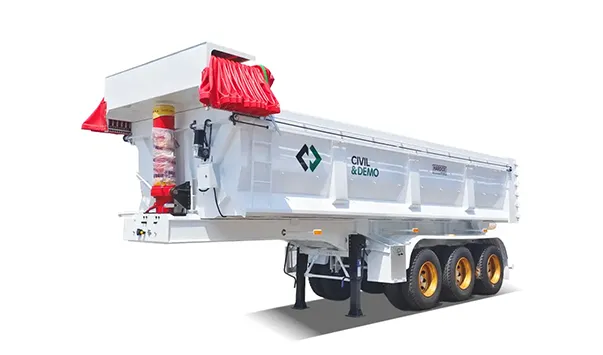
An end dump trailer uses a hydraulic lifting system to raise the front of the dump body so material exits through the rear. For heavy-duty construction, mining, aggregate, and infrastructure work, buyers should compare payload, body volume, axle layout, steel thickness, hydraulic cylinder, suspension, braking, and local road limits before choosing a trailer.
What Is a Dump Trailer and How Does an End Dump Trailer Work?
A damperli römork is a trailer designed to carry loose bulk material and unload it by tipping the cargo body. Instead of workers removing material by hand, a hydraulic system lifts the body and lets gravity move the load out.
An end dump trailer tips toward the rear. The front of the body rises while the rear stays near the chassis. Sand, coal, gravel, ore, stone, soil, and demolition material then move toward the rear gate and unload.
The basic working sequence is simple:
- Load the dump body.
- Transport the cargo to the site.
- Park on suitable, stable ground.
- Open or release the rear gate as required.
- Activate the hydraulic lifting system.
- Raise the body gradually.
- Let the material unload.
- Lower the body before moving again.
That sounds easy. The engineering behind it is not.
A heavy load moves as the body rises. This changes the trailer’s center of gravity. The chassis, axle arrangement, suspension, hydraulic system, body shape, and ground conditions all affect stability.
That is why, as a semi trailer manufacturer, we do not look at a semi dump trailer as just a steel box with a cylinder. We start with the cargo, road conditions, target payload, loading equipment, and unloading environment.

End Dump Trailer vs. Dump Truck vs. Side Dump: What Is the Difference?
A dump truck carries its dump body directly on the truck chassis. The cab, engine, chassis, and cargo body operate as one vehicle.
A dump semi-trailer works differently. The tractor supplies pulling power, while the trailer carries the bulk material. This makes it easier for a fleet to separate the tractor from the trailer and use tractors with different equipment.
| Equipment Type |
How It Unloads |
Typical Strength |
Tipik Kullanım |
| End dump trailer |
Rear tipping |
Large payload and simple unloading path |
Sand, gravel, ore, construction material |
| Side dump |
Tips to one side |
Fast lateral discharge |
Mining, road work, aggregate |
| Dump truck |
Rear or side tipping |
High maneuverability |
Short-distance construction and site work |
| Yardımcı römork |
Usually manual or small hydraulic system |
Light-duty flexibility |
Landscaping and small jobs |
A side dump can unload material without raising the body as high as some rear-tipping designs, but it needs enough side clearance. An end-dump trailer needs clear overhead space and a stable unloading surface.
The right design depends on where the equipment works.
For a large mine, a heavy-duty end dump may be practical because it can move a large payload over longer distances. For a tight urban job site, a dump truck may be easier to maneuver. A small utility trailer belongs to a completely different duty class.
What Makes a Heavy-Duty Dump Trailer Durable?
A heavy-duty damperli römork must handle more than static weight. It faces repeated loading impact, road vibration, twisting forces, abrasion from cargo, and stress during tipping.
The main structure usually deserves the most attention.
Main Beam and Chassis
The chassis carries forces from the tractor, axles, suspension, dump body, and hydraulic system. CHENLU’s publicly listed dump configurations use reinforced steel main beams, with some current configurations specifying Q345 structural steel. Product specifications vary by model and project, so the final material should always be confirmed on the approved drawing.
Floor and Sidewall Thickness
Different cargo wears steel at different rates.
Fine sand is not the same as broken rock. Coal is not the same as iron ore. A trailer that works well for one cargo may wear too quickly with another.
Current CHENLU dump product pages show selected configurations with an 8 mm floor and 6 mm sidewall, while other project-specific models use thicker steel. These numbers are not universal specifications for every dump trailer.
For abrasive material, we may recommend thicker plate or wear-resistant steel.
Welding and Reinforcement
Good steel does little if weld quality is poor.
Critical areas include:
- Hydraulic cylinder mounting points
- Main beam joints
- Cross-members
- Axle and suspension brackets
- Body pivot area
- Rear gate
- Upper and lower body rails
CHENLU’s manufacturing process covers material preparation, beam welding, frame assembly, surface treatment, painting, final assembly, and inspection. The company also states that axles, suspension, brakes, electrical systems, and key weld areas are checked during production.
That process matters because a dump trailer lives a hard life. Small fabrication problems rarely stay small.

How Do Axle Layout, Payload, and Cubic Capacity Affect a Dump Trailer?
Current CHENLU product information includes selected üç dingilli configurations around the 40–60 ton range and four-axle configurations designed for heavier applications. A current four-axle CHENLU tipper project page also describes a 35 m³ configuration for construction materials. These are model-specific examples, not universal limits.
Why Axle Count Matters
Axles spread load over the road.
A triaxle configuration is common in heavy bulk transport. Four-axle designs may support different load-distribution requirements, but adding another axle does not automatically make a trailer legally able to carry more weight.
Road rules still matter.
For example, on the U.S. Interstate Highway System, FHWA lists federal maximum standards of:
- 20,000 lb for a single axle
- 34,000 lb for a tandem axle
- 80,000 lb gross vehicle weight, subject to the Federal Bridge Formula
Rules outside the Interstate system can differ by state.

Frameless Dump Trailer vs. Frame-Type End Dump Trailer: Which Is Better?
A frameless dump trailer uses the dump body itself as a major structural element instead of relying on a complete conventional frame beneath the body.
The design can reduce empty weight in some applications, which may help payload. An aluminum or frameless aluminum end dump can be attractive when low tare weight matters.
A conventional frame-type end-dump trailer uses a dedicated chassis under the body. This design is common in demanding construction and mining markets because the structure can be reinforced for rough roads and high-impact loading.
Neither approach is automatically better.
A buyer comparing a frameless dump trailer, steel dump, or aluminum dump should evaluate:
| Faktör |
Neden Önemlidir |
| Boş ağırlık |
Affects useful payload |
| Cargo abrasion |
Influences body material choice |
| Yol kalitesi |
Rough roads increase structural stress |
| Dump frequency |
More cycles increase fatigue |
| Repair network |
Affects downtime |
| Corrosion |
Important for some climates and cargo |
| Purchase cost |
Must be balanced against service life |
A half round body is another design buyers may see. Its curved interior can help material flow and reduce corners where material can collect. Other operations prefer rectangular or U-shaped bodies.
Again, there is no universal winner.
CHENLU currently focuses on reinforced heavy-duty dump and tipper configurations for construction, mining, sand, coal, gravel, stone, and ore transport.
How Do You Choose a Heavy-Duty Dump Trailer Manufacturer?
When buying factory-direct, the manufacturer should help you answer technical questions before production starts.
As a professional semi-trailer manufacturer in China, we focus on OEM and ODM solutions for fleets, mining companies, construction contractors, distributors, and international project buyers.
Our process starts with a few basic questions:
What are you hauling?
Sand and coal do not wear a dump body in the same way as rock and ore.
How much do you need to haul?
Payload determines far more than body size. It affects axles, tires, suspension, chassis strength, and hydraulic design.
Where will the trailer work?
Highway transport, mines, construction sites, desert roads, and mountain routes create different loads.
Yükü nasıl boşaltacaksınız?
You need enough overhead space, ground stability, and tipping clearance.
CHENLU currently offers three- and four-axle dump and tipper solutions, with customization available for body structure, steel thickness, suspension, axle configuration, hydraulic systems, colors, branding, and project requirements. The broader company service process covers design confirmation, production, inspection, shipping documents, and after-sales support.
Sık Sorulan Sorular
What is the difference between an end dump trailer and a dump truck?
An end dump trailer has no engine and must connect to a tractor. A dump truck combines the engine, cab, chassis, and dump body in one vehicle. A trailer is often more flexible for highway fleet operations, while a dump truck can be useful on shorter or tighter routes.
How many tons can an end dump trailer carry?
There is no universal number. Current CHENLU pages show selected three-axle configurations in approximately the 40–60 ton range and heavier four-axle configurations for larger payload requirements. Legal payload still depends on trailer tare weight, tractor weight, axle spacing, road rules, and cargo density.
Is a three-axle or four-axle dump trailer better?
Neither is always better. Three axles can provide a practical balance of capacity, cost, weight, and maneuverability. Four axles may help distribute heavier loads. Local axle and gross-weight rules should determine the final configuration.
What steel thickness should I choose?
It depends on the cargo. Sand and coal usually create less severe impact and abrasion than stone, ore, or demolition debris. CHENLU can adjust floor and sidewall thickness according to the material and duty cycle.
Can I add a roll tarp to my dump trailer?
Yes, tarp systems can be customized depending on the body design and operating requirements. Manual, roll tarp, and electric cover options may be considered. Confirm local cargo-cover rules before choosing the system.
Should I buy a new or used end dump trailer?
Used equipment can reduce initial investment, but inspect the main frame, body, welds, pivot points, hydraulic cylinder, suspension, axles, brakes, tires, and corrosion carefully. New OEM equipment can be designed around your payload, cargo, route, and regulations from the beginning.



 27 Ağustos 2026