A lowboy that looks strong enough can still be wrong for the job. Too much deck height, poor axle distribution, or the wrong loading method can delay a haul and raise operating costs. The safest buying process starts with the machine—not the trailer catalog.
A lowbed semi trailer or lowboy trailer should be selected from the equipment’s weight, length, width, height, ground clearance, loading method, tractor setup, axle limits, and route conditions. A 3 axle lowbed trailer suits many construction machines, while heavier, taller, or difficult-to-load equipment may require a 4-axle, hydraulic, RGN, or custom lowboy trailer.
Makale Taslağı
- What is a lowbed semi trailer, and when should you use one?
- Which type of lowboy trailer fits your machine?
- How do equipment dimensions determine lowboy trailer dimensions?
- 3 axle or 4 axle: how many axles should a lowboy use?
- Lowboy vs. step deck, double drop, and flatbed: which is the right trailer?
- How do roads and tractor setup affect heavy haul trailer design?
- What can a real 3 axle lowbed project teach buyers?
- What should you send a manufacturer before ordering a custom lowboy trailer?
- Sıkça sorulan sorular
What Is a Lowbed Semi Trailer, and When Should You Use One?
If you search what is lowboy trailer, the usual answer is that it is a heavy-equipment semi-trailer with a low cargo platform. That definition is correct, but it does not tell a buyer whether the trailer actually fits the machine.
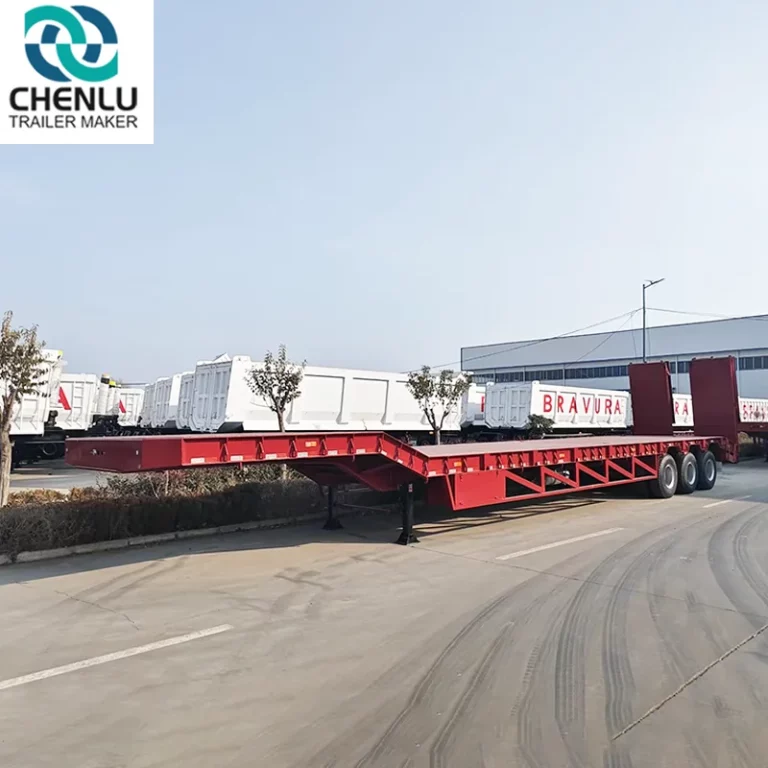
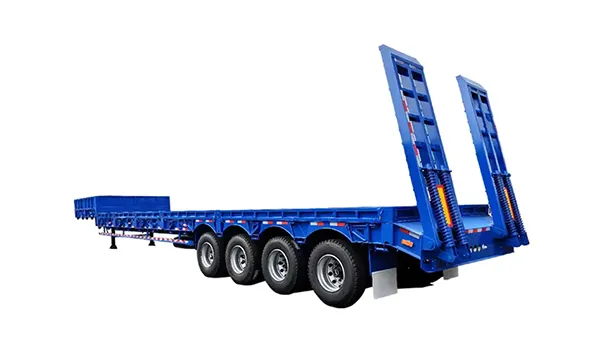
A low bed semi trailer places most of the equipment on a lower loading deck than a standard flatbed. This helps reduce overall loaded height and can improve stability by keeping the machine closer to the road. CHENLU currently positions its lowbed range for excavators, bulldozers, loaders, mining machinery, and other large equipment.
Typical users include:
- İnşaat müteahhitleri
- Mining operators
- Heavy-equipment rental companies
- Infrastructure contractors
- Machinery dealers
- Equipment logistics companies
- Treyler dağıtıcıları
- International project buyers
A semi lowboy trailer makes the most sense when the cargo is too tall, too heavy, or too concentrated for an ordinary general-cargo platform.
The important word is configuration.
A 25-ton excavator, a 50-ton crawler, and an oversized drilling machine may all be called “heavy equipment,” but they should not automatically use the same trailer.

Which Type of Lowboy Trailer Fits Your Machine?
There are several different types of lowboy products. Choosing the type of lowboy trailer should begin with how the machine gets onto the trailer and where its weight sits after loading.
Standard Fixed-Neck Lowboy
A fixed neck lowboy normally loads machinery from the rear using ramps.
It offers:
Relatively simple construction
Straightforward maintenance
Good suitability for common excavators and loaders
Mechanical or hydraulic ramp options
This is one of the most practical equipment lowboy trailers for construction fleets that repeatedly move standard machines.
Hydraulic-Ramp Lowboy
A hydraulic-ramp model keeps the same basic rear-loading concept but uses hydraulic cylinders to raise and lower the ramps.
CHENLU’nun şu anki hydraulic-ladder lowbed range is designed to reduce manual ramp handling and make loading easier for large machinery.

RGN Lowboy
An RGN uses a removable or detachable front neck. When the operator releases the gooseneck, the front of the trailer can lower toward the ground.
This creates a front loading path.
An RGN trailer is especially useful for:
- Buldozerler
- Large excavators
- Crawler machines
- Low-clearance equipment
- Machines that struggle with steep rear ramps
Multi-Axle Lowboy
For larger concentrated loads, the trailer may use four or more axle positions.
CHENLU also publishes multi-axle lowbed solutions for oversized machinery and industrial transport on difficult roads.
The best type of lowboy is therefore not the one with the largest capacity number. It is the one that matches the machine and route with the least unnecessary complexity.
How Do Equipment Dimensions Determine Lowboy Trailer Dimensions?
The most useful trailer specification often comes from the machine specification.
Before discussing lowboy trailer dimensions, collect six numbers:
| Makine Verileri |
Neden Önemlidir |
| Operating Weight |
Determines trailer frame strength and axle requirements |
| Toplam Uzunluk |
Determines the required usable deck length |
| Overall Width |
Determines deck width and potential permit requirements |
| Toplam Yükseklik |
Determines the total loaded transport height |
| Yerden Yükseklik |
Affects the required loading ramp angle |
| Track / Wheel Position |
Affects concentrated load placement and weight distribution |
CHENLU’s current technical guidance stresses that deck length and width alone are not enough. Buyers should also consider loaded deck height, ramp angle, axle spacing, gooseneck geometry, and the machine’s center of gravity.
Deck Height
The deck height helps control the overall height of the loaded vehicle.
A taller excavator may fit a lowboy but exceed a route’s height limits when placed on a higher trailer.
Deck Length
The deck length must support the machine’s tracks or wheels in the correct position.
Too little usable deck space can force poor weight distribution.
Genişlik
A wider machine may require:
Wider main deck
Removable side extensions
Outriggers
Oversize permits
This is why a custom lowboy trailer should begin with the machine drawing or actual measured dimensions.
As a manufacturer, we would rather receive a simple equipment drawing than guess from the phrase “60 ton excavator.”
3 Axle or 4 Axle: How Many Axles Should a Lowboy Use?
The number of axles affects load distribution, tire count, suspension requirements, maneuverability, tare weight, and maintenance.
A 3 dingilli lowbed römork is one of the most common configurations for construction machinery because it balances capacity and operating simplicity.
CHENLU’s current public product-family information shows:
More axle positions can distribute the load over more tires, but that does not mean a four-axle trailer automatically has a higher legal payload everywhere.
A heavier configuration also adds:
- Tire cost
- Brake parts
- Rulmanlar
- Süspansiyon parçaları
- Römorkun boş ağırlığı
- Maintenance points
For this reason, we do not recommend adding axles just because the trailer “looks stronger.”
The correct axle count depends on:
- Makine ağırlığı
- Machine center of gravity
- Tractor weight
- Römorkun boş ağırlığı
- Dingil aralığı
- Yerel aks sınırları
- Lastik derecelendirmeleri
- Road and bridge rules
A 3 axle model may be the right lowboy trailer for one 50-ton machine, while another machine with the same total weight may need a different design because the load is concentrated in a smaller area.

What Can a Real 3 Axle Lowbed Project Teach Buyers?
CHENLU has published a case involving a batch of 3-axle low-bed semi-trailers shipped to Nigeria for heavy machinery and large cargo.
The published case highlights:
- Low loading platform
- Thickened and widened main-beam structure
- High-strength materials
- Heavy-equipment transport
- Uzun mesafeli çalışma
- Complex road conditions
The company states that the design aimed to keep the load center lower and support stable transport under high-load use.
This case is useful because it shows the type of questions buyers should ask.
The important point is not simply that the trailer had three axles.
The real questions are:
- What machinery was being moved?
- What road conditions did the trailer need to tolerate?
- How should the main beam be reinforced?
- What loading height was required?
- What axle distribution worked with the tractor?
That is how a lowboy equipment trailer becomes a project-specific solution.
CHENLU also publishes multi-axle deliveries to Africa for oversized machinery and heavy industrial cargo, showing that standard three-axle equipment and special heavy-haul projects should be treated as different configuration classes.
What Should You Send a Manufacturer Before Ordering a Custom Lowboy Trailer?
For OEM or ODM work, better input creates a better quotation.
Bir profesyonel olarak yarı römork üreticisi in China, we prefer to start with actual operating data.
Machine Information
- Ekipman adı
- Marka ve model
- Operating weight
- Uzunluk
- Genişlik
- Yükseklik
- Yerden yükseklik
- Ray veya tekerlek aralığı
Traktör Bilgileri
- Yarı kamyon modeli
- Beşinci tekerlek yüksekliği
- Traktör aks düzeni
Güzergâh Bilgileri
- Hedef ülke
- Road type
- Yerel aks sınırları
- Maximum width or height requirements
- Mine or construction-site conditions
Loading Information
- Rear loading or front loading
- Mechanical or hydraulic ramp
- Yükleme sıklığı
- Crane loading if required
Ticari Bilgiler
- Sipariş miktarı
- Required delivery schedule
- Logo and color
- Spare-parts requirements
- Varış limanı
CHENLU‘s current support process follows the same broad logic: buyers first provide cargo, loading weight, route, and project requirements; the engineering team then recommends a suitable configuration before final quotation and production.
For a custom lowboy trailer, this is much safer than simply saying:
“Send me your biggest lowboy.”
A good trailer is not the biggest trailer.
It is the one that does the required work with the right structure, weight, loading system, and operating cost.
Sık Sorulan Sorular
What is the difference between a lowbed semi trailer and a lowboy semi trailer?
The terms often describe the same broad class of low-deck heavy-equipment semi-trailers. Lowbed semi trailer is widely used in international markets, while lowboy semi trailer is common in North American terminology. The exact structure still depends on deck design, axles, ramps, and gooseneck configuration.
Is a 3 axle lowbed trailer enough for an excavator?
It can be, but the answer depends on the excavator’s real weight, dimensions, center of gravity, and local axle limits. Current CHENLU three-axle product-family information covers approximately 30–60 tons, but the final approved configuration should determine the actual capacity.
What is the difference between a lowboy and an RGN?
A standard lowboy normally uses rear ramps. An RGN uses a removable gooseneck so the front of the trailer can lower for drive-on loading. RGN designs are especially useful for large crawler equipment.
Can I order a hydraulic detachable gooseneck lowboy?
Yes. A hydraulic detachable design can use a hydraulic system to separate and reconnect the front gooseneck. This can improve loading convenience for fleets that regularly move crawler machinery.
Is a lowboy trailer for pickup truck the same product?
No. A lowboy trailer for pickup truck normally belongs to a much lighter equipment-trailer class with different couplings, brakes, axle ratings, and weight limits. CHENLU’s lowbed and lowboy products discussed here are heavy-duty semi-trailers intended for tractor units.
What is a lowboy truck?
The term lowboy truck is often used informally for a tractor pulling a lowboy trailer. Technically, the lowboy is the trailer, while the powered truck is the tractor or semi truck.



 5 Eylül 2026