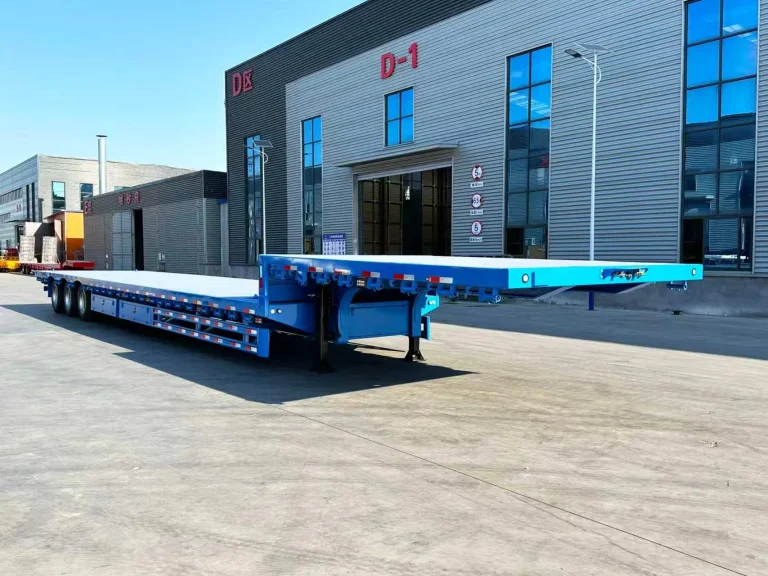
A container fleet can lose time and money when its trailer is too heavy, difficult to turn, poorly matched to the container, or built for the wrong road conditions. A well-designed skeleton semi trailer solves these problems with a purpose-built chassis, secure twist locks, and the right axle configuration.
A skeleton semi trailer is an open-frame container chassis designed mainly for transporting standard 20ft and 40ft shipping containers. Compared with a full-deck flatbed, the skeletal structure reduces unnecessary platform weight and focuses the chassis on dedicated container transport. Two-axle designs suit maneuverable port operations, while three-axle configurations can better support long-haul intermodal work.

Makale Taslağı
- What is a skeleton semi trailer?
- Why does a skeletal trailer work well for container transport?
- How do 20ft and 40ft container configurations differ?
- What is the difference between 2 axles and a 3 axle container chassis?
- How do the chassis, main beam, and weld quality affect durability?
- Why are twist locks important on a container trailer?
- Skeleton trailer or flatbed semi trailer: which is more suitable?
- How do brakes, suspension, and running gear affect operations?
- Where do skeleton semi trailers create the most value?
- How does OEM customization support international container fleets?
- What should buyers know about trailer price and factory support?
What Is a Skeleton Semi Trailer?
A skeleton semi trailer also called a skeletal trailer or container chassis, is a semi-trailer with an open structural frame instead of a full flat deck. Its main purpose is to carry a standardized shipping container by supporting and locking it at specific structural points.
The design is simple in appearance. Yet every part has a clear job. The longitudinal chassis rails carry the main forces. Cross-members and container bolsters support the load. A twist lock secures each required corner position. The axle group carries the rear load, while the front of the trailer transfers part of the weight to the semi truck through the kingpin and fifth wheel.
CHENLU’nun şu anki İskelet Fragmanı category is centered on a 2 Axle Skeleton Trailer for 20ft and 40ft standard container operations. The published model has a maximum payload of 30 tons, two 13-ton FUWA axles, leaf-spring suspension, JOST E100 landing gear, a 2-inch or 3.5-inch JOST kingpin, and 12 container twist locks.
This dedicated layout explains why the skeleton design differs from general-purpose semi trailers. It is not trying to provide a deck for every cargo type. It focuses its structure on container handling.
For port operators and logistics fleets, that specialization can be valuable.

Why Does a Skeletal Trailer Work So Well for Container Transport?
Container logistics depends on standardization. A shipping container must move from ship to terminal, truck, rail, depot, and warehouse with as little handling complexity as possible.
ISO’s freight-container standards cover areas such as dimensions, ratings, and container fittings. ISO 668 addresses classification, dimensions, and ratings for Series 1 freight containers, while ISO 1161 specifies functional and strength requirements for container corner and intermediate fittings.
A container skeletal trailer works within this intermodal system. Instead of carrying the container on a continuous steel deck, the chassis supports it at engineered points and secures it with locks that engage the container’s corner fittings.
The open-frame structure can offer several operational advantages:
- Lower tare-weight direction than a comparable full-deck trailer
- Clear focus on dedicated container work
- Easier access to chassis components
- Efficient port and terminal operations
- Flexible engineering for 20ft and 40ft container positions
- Good fleet standardization for repeat routes
CHENLU positions the 2-axle model especially for short-distance port transfers because its shorter wheelbase improves turning radius and maneuverability in busy terminals. Its broader container-trailer page positions the 3-axle version toward long-haul intermodal logistics and heavy 40ft container operations.
That is an important distinction. A good trailer does not simply carry a box. It matches the transport environment.
How Do 20ft and 40ft Skeleton Trailer Configurations Differ?
A 20ftcontainer and a 40ft container place their corner fittings at different positions along the chassis. Therefore, the trailer frame and locking layout must support the required container size correctly.
CHENLU’s current 2-axle product is described primarily as suitable for20ft and 40ft standard containers. The model page also contains a separate statement mentioning a 45-foot container, but this conflicts with the clearer 20–40ft category positioning. For that reason, 45ft compatibility should be confirmed against the final chassis length and locking layout rather than assumed.
A typical project discussion should identify whether the fleet needs:
| Container Requirement |
Chassis Design Question |
| One 20ft container |
Where must the locks and load support points be positioned? |
| One 40ft container |
Is the chassis optimized for full-length 40ft operation? |
| 20ft and 40ft |
Does the frame provide both required locking layouts? |
| 40ft high cube |
Does the route have height restrictions? |
| 45-foot konteyner |
Is the exact chassis and lock layout confirmed? |
A 20ft skeleton semi trailer can be optimized for compact port work. A 40ft skeleton semi trailer needs a longer chassis and must handle the weight distribution created by a full-length box.
CHENLU’s separate container-solutions page also presents a gooseneck container chassis for high-cube applications where overall transport height matters.
This shows why container size is not merely a marketing label. It changes the trailer geometry.
What Is the Difference Between 2 Axles and a 3 Axle Skeleton Trailer?
Axle configuration affects weight distribution, maneuverability, tire count, maintenance, road compliance, and how the trailer behaves on different routes.
The current CHENLU 2-axle model uses 2 axles, specifically two 13T FUWA axles according to its published specification. CHENLU positions this chassis for port work and short-distance container delivery where maneuverability is especially valuable. ([陈鲁挂车][3])
A 3 axle skeletal design serves a different operating direction. CHENLU’s container-trailer page describes a 3-axle skeletal container trailer as suitable for long-haul intermodal logistics and heavy 40ft shipping containers, where more load-distribution capability and highway stability may be desirable.
A simplified comparison looks like this:
| Yapılandırma |
Başlıca Güç Noktası |
Typical Direction |
| 2 Axle |
Shorter wheelbase, maneuverability |
Port and short-haul work |
| 3 Aks |
More load-distribution potential |
Highway and longer routes |
| Multi-axle |
Market/project dependent |
Special legal or load requirements |
A tri axle skeletal trailer is not automatically better. An extra axle adds tires, hubs, brakes, suspension components, tare weight, and maintenance points.
The correct configuration depends on:
- Gross vehicle limits
- Yasal aks yükü
- Tractor configuration
- Container weight
- Highway rules
- Bridge regulations
- Turning conditions
- Yol kalitesi
This is why phrases such as 3 axle 40ft or “axle 40ft container chassis” should lead to a technical discussion, not a fixed global specification.
CHENLU has also published a Tanzania project in which 3-axle skeletal container trailers were supplied for inland distribution, with heavy-duty mechanical suspension described for challenging road conditions. The public case information does not provide enough model-specific data to apply the same payload, lock count, or axle rating to every 3-axle product.

How Do the Chassis, Main Beam, and Weld Quality Affect Durability?
The container is held at only a limited number of structural points, so the chassis frame must control bending, torsion, vibration, and repeated loading cycles.
The main beam is therefore one of the most important parts of any skeleton trailer.
CHENLU’s container-product material describes high-strength steel chassis construction and identifies Q345B/Q460 as steel directions at the series level. It also states that main beams may use submerged-arc welding. The exact grade for the current 2-axle model should still be confirmed in its final production specification because the specific product page only states “steel” and “high strength steel.” ([陈鲁挂车][3])
A durable skeleton chassis depends on more than the name of the steel. Important factors include:
- Beam geometry
- Plate thickness
- Çapraz eleman aralığı
- Container bolster reinforcement
- Kingpin takviyesi
- Axle mounting accuracy
- Weld penetration and consistency
- Overall chassis alignment
Repeated container work creates fatigue cycles. Every pickup, road vibration, brake event, turn, and unloading operation places stress into the frame.
That is why weld quality matters.
CHENLU’s published manufacturing process includes seven stages: material preparation, main-beam welding, frame assembly, surface treatment, painting, final assembly, and inspection/testing. The company’s quality-control page also lists raw-material checks, critical-weld inspection, axle and suspension inspection, brake checks, and electrical and air-system testing.
For buyers focused on heavy duty and extra durability, those production controls are more meaningful than a broad marketing phrase such as “strong trailer.”

Why Are Twist Locks Critical on a Container Trailer?
A shipping container must remain securely connected to the trailer during acceleration, braking, cornering, rough-road vibration, and emergency maneuvers.
That job belongs to the container-locking system.
ISO 1161 defines dimensional and functional requirements for the corner and intermediate fittings used on Series 1 freight containers. Those standardized fittings are central to container interchange between different transport systems.
CHENLU’s current 2 axle skeleton semi product specifies:12 pieces twist locks
for the published model.
At series level, CHENLU’s container-trailer page also mentions 4-, 8-, and 12-lock configurations depending on the intended container arrangement.
The exact number should therefore follow the chassis design rather than be copied blindly from another trailer.
Important checks include:
- Lock position
- Lock engagement
- Welded support structure
- Ease of operation
- Damage or deformation
- Corrosion
- Compatibility with the intended container arrangement
A twist lock may look small compared with the full 40ft container chassis, but it is a critical connection between cargo and vehicle.
Before each trip, the operator should confirm that the required locks are fully engaged.
Skeleton Trailer or Flatbed Semi Trailer: Which One Fits the Operation?
A skeleton trailer and a flatbed semi trailer can both move containers, but they solve different business problems.
The skeleton has no complete loading deck. It exists mainly for container work.
A flatbed trailer provides a solid platform. It can carry a shipping container when suitable locks are installed, but after the box is removed, the same flatbed can also haul steel, timber, pallets, equipment, or other general freight.
CHENLU’s container-product comparison follows the same logic: skeleton chassis for dedicated container operations and container flatbeds for mixed logistics.
| Business Model |
Better Direction |
| Dedicated port container fleet |
Skeleton fragmanı |
| Port-to-depot container work |
Skeleton fragmanı |
| Containers + steel |
Düz yataklı |
| Containers + construction cargo |
Düz yataklı |
| Mixed backhaul freight |
Düz yataklı |
| High-volume dedicated intermodal container operation |
Skeleton fragmanı |
The skeleton’s advantage is focus.The flatbed advantage is versatility.
For a logistics company whose return journey often has general freight available, the flatbed may improve vehicle utilization. For a port operator moving boxes continuously between terminal stacks and depots, the lighter dedicated container chassis trailer
may be the more efficient tool.
There is no single winner. The right trailer follows the revenue model.
How Do Brake, Suspension, and Running Gear Affect Container Operations?
A container chassis does not operate as a steel frame alone. Its running gear determines how that frame interacts with the road.
The current CHENLU 2 Axle Skeleton Trailer specifies leaf-spring suspension and two 13T FUWA axles. It also lists JOST E100 landing gear and either a 2-inch or 3.5-inch JOST kingpin. Tire configuration is listed as customizable.
The broader CHENLU container page discusses mechanical or air suspension configurations and describes WABCO ABS in connection with its 3-axle highway-oriented container trailer. Because there is no separate fully specified 3-axle product page in the current Skeleton category, that brake equipment should be treated as a series-level configuration direction rather than standard equipment on every skeleton trailer.
Running-gear choices affect:
- Road stability
- Maintenance requirements
- Spare-parts availability
- Ride behavior
- Tire wear
- Axle load distribution
- Fleet standardization
A rough-road market may prioritize robust mechanical suspension. A high-speed paved-road fleet may evaluate air suspension where local regulations, cost, and service capability support it.
The same applies to components.
CHENLU states that it tries to select wear parts such as brake components, bearings, and tires from brands that can be sourced in customers’ local markets, and it can also supply spare parts with international orders.
That can matter more over five years than saving a small amount on the original trailer price
Where Does a Skeleton Container Trailer Create the Most Value?
A dedicated container chassis is especially useful in operations where the cargo unit is always—or almost always—a standardized container.
Key applications include:
- Container ports
- Inland container depots
- Shipping-line operations
- Port-to-city delivery
- Intermodal terminals
- Railway container connections
- Distribution centers
- Export logistics
- Container fleet leasing
- Industrial container transport
The short-wheelbase 2-axle model is especially relevant to terminals where drivers need to turn repeatedly in confined lanes. CHENLU explicitly positions its current 2-axle chassis around this operating environment.
Longer-distance work changes the priority.
When a loaded 40ft container travels from a coastal port to an inland distribution center, road stability, fatigue resistance, brake performance, axle distribution, and driver confidence become increasingly important.
This is where the 3 axle or another project-specific configuration may make sense.
The word intermodal container chassis captures the larger idea: the trailer forms the road link in a chain that may also involve ships, cranes, railcars, container yards, and warehouses.
Standardized containers made this system possible. ISO notes that standardization of freight-container dimensions and fittings helped create compatibility across global transport networks.
The trailer is one link, but it is an essential one.

How Does OEM Customization Support International Container Fleets?
A yarı römork üreticisi serving different countries cannot rely on one fixed design.
A container operator in Indonesia may face crowded terminals. A customer in Tanzania may need stronger suspension for difficult inland roads. A Middle Eastern fleet may focus on high-speed highway stability and high-cube container clearance.
CHENLU’s current container page publishes examples covering those types of applications, including short-wheelbase 2-axle chassis for Indonesia, 3-axle skeletal trailers for Tanzania, container flatbeds for the Philippines, and gooseneck chassis for Saudi Arabia.
For an OEM container project, useful information includes:
1. Container sizes
2. Loaded container weight
3. Tractor model
4. Fifth-wheel height
5. Legal axle load
6. Required number of axles
7. Road condition
8. Typical trip distance
9. Suspension preference
10. Tire standard
11. Brake requirements
12. Twist-lock arrangement
13. Port and turning-space conditions
14. Fleet branding requirements
CHENLU’s support process begins with cargo, target payload, working conditions, and local regulations before configuration is recommended. The company states that production normally takes around 10–30 days after deposit, depending on product type and customization requirements.
For B2B buyers, this matters because a container skeleton semi should work with the fleet that already exists.
OEM should not mean changing only the paint.
It should mean adapting the chassis to the actual operation.
What Should Buyers Know About Skeleton Trailer Price and Factory Support?
Search phrases such as trailer for sale, semi trailer for sale, skeletal trailer for sale, and container chassis for sale usually signal that a buyer is moving from research toward procurement.
The current CHENLU 2 Axle Skeleton Trailer page publicly lists a reference price of USD 7,300. It also displays 500 pieces per month and a two-year warranty. However, the current company support page gives a one-year warranty, so the two-year product-page figure should be confirmed before it is used in a contract or quotation.
Final semi trailer price can change with:
- Aks sayısı
- Axle brand
- Süspansiyon
- Steel specification
- Tire configuration
- Brake package
- Römork boyutları
- Döner kilitli düzen
- Sipariş miktarı
- Destination
- Kargo yöntemi
- OEM requirements
A 40ft skeleton trailer for sale should therefore be compared by specification, not only by headline price.
The same applies when buyers encounter search phrases such as Titan skeleton or Titan 3 axle. Those may refer to another manufacturer’s products or to market comparison searches. A CHENLU buyer should compare actual chassis design, axle configuration, lock layout, materials, manufacturing controls, warranty, parts availability, and export support instead of assuming different brands use interchangeable specifications.
CHENLU identifies itself as an industry-and-trade integrated enterprise established in 2008 and offers production tracking, inspection, RO-RO/bulk/container/flat-rack shipping arrangements, export documents, spare parts, and technical support.
For distributors and large fleets, those services can be part of the product value.
Skeleton Semi Trailer Specifications: What Is Currently Confirmed?
For the current CHENLU 2 Axle Skeleton Trailer, the most reliable public model-specific information is:
| Özellikler |
Current Published Information |
| Product |
2 Dingilli İskelet Treyler |
| Römork Türü |
Yarı Römork |
| Ana İşlev |
Konteyner şasisi |
| Primary Container Application |
20ft and 40ft |
| Maximum Payload |
30T |
| Malzeme |
Çelik |
| Aks |
2 × 13T FUWA |
| Süspansiyon |
Leaf spring |
| İniş Takımları |
JOST E100 |
| Anahtar kişi |
2″ or 3.5″ JOST |
| Twist Locks |
12 pieces |
| Lastik |
Customizable |
| Boyut |
Buyer’s request |
| Public Reference Price |
USD 7,300 |
These skeleton semi trailer specifications come from the current product page.
Several other details should remain project-specific or To be confirmed, including exact chassis dimensions, tare weight, axle spacing, exact steel grade, tire quantity, brake specification, ABS, 45ft compatibility, and the final contractual warranty.
This distinction is useful.
Good engineering content should separate what is published from what is assumed.
Sık Sorulan Sorular
What is a skeleton semi trailer?
A skeleton semi trailer is an open-frame container semi trailer designed primarily to carry standardized shipping containers. It uses a structural chassis and container locking points instead of a complete flat loading platform.
Can a skeleton trailer carry both 20ft and 40ft containers?
CHENLU’s current 2-axle product is designed primarily for 20ft and 40ft standard container transport. The exact locking positions should be confirmed for the final chassis arrangement.
What is the difference between a 2 axle and 3 axle skeleton trailer?
A 2-axle chassis can offer a shorter wheelbase and good maneuverability for terminal and short-haul work. A 3 axle chassis may be selected for longer routes or different legal load-distribution requirements. The correct choice depends on the container, tractor, roads, and local regulations.
Can a skeleton trailer transport a 45-foot container?
The current 2-axle page contains a reference to 45ft compatibility, but the category and main product description focus on 20–40ft transport. Therefore, a 45-foot container should only be used after chassis length and twist-lock positions are confirmed for the specific order.
How is a skeleton trailer different from a flatbed trailer?
A skeleton trailer is dedicated mainly to containers and has an open chassis structure. A flatbed provides a full deck, allowing it to carry containers as well as steel, timber, pallets, and other general freight. CHENLU recommends skeleton chassis for dedicated container fleets and flatbeds for mixed logistics.
How do drivers unload the container from a skeleton trailer?
The chassis itself normally does not lift or unload the container. Container handling is usually performed by port cranes, reach stackers, container handlers, or other suitable terminal equipment. The trailer transports and secures the container between handling points.
A Skeleton Chassis Is a Specialized Link in Global Container Logistics
A container may cross an ocean on a vessel and travel hundreds of kilometers by road, but its road journey depends on a relatively simple-looking piece of equipment: the shipping container chassis.
That chassis must do several jobs well.
It must position the container correctly. It must secure it. It must transfer forces into the tractor and axle group. It must survive repeated loading cycles. And it must operate efficiently in the roads, ports, and terminals where the fleet earns its revenue.
For dedicated container work, a skeleton design removes the full platform found on a flatbed and focuses the structure on container transport. The result can be a lighter, purpose-built trailer for repetitive logistics operations.
CHENLU currently offers a 2-axle model for 20ft and 40ft container work and presents a broader product direction that includes 3-axle and gooseneck chassis solutions. As a professional trailer manufacturer in China, we also provide OEM / ODM support for axle layout, suspension, container locks, chassis structure, running gear, branding, and export requirements.
It is the one that matches your containers, tractor, roads, legal axle limits, trip distance, terminal conditions, maintenance network, and business model.
That is where engineering becomes operating value.



 18 Ağustos 2026